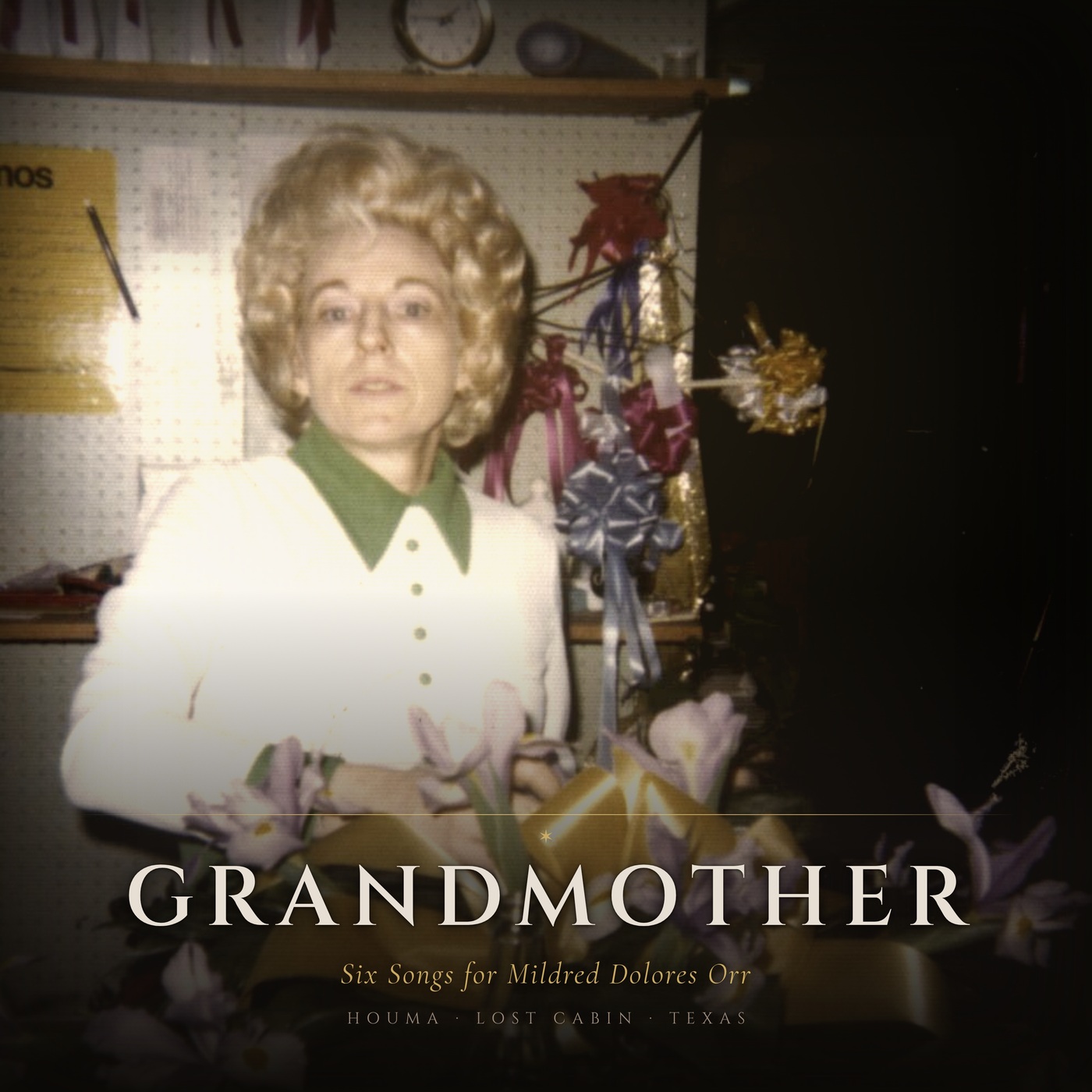
Mildred Orr, called Sissy, standing behind a spray of irises and gold ribbon in her flower shop in Houma, Louisiana.
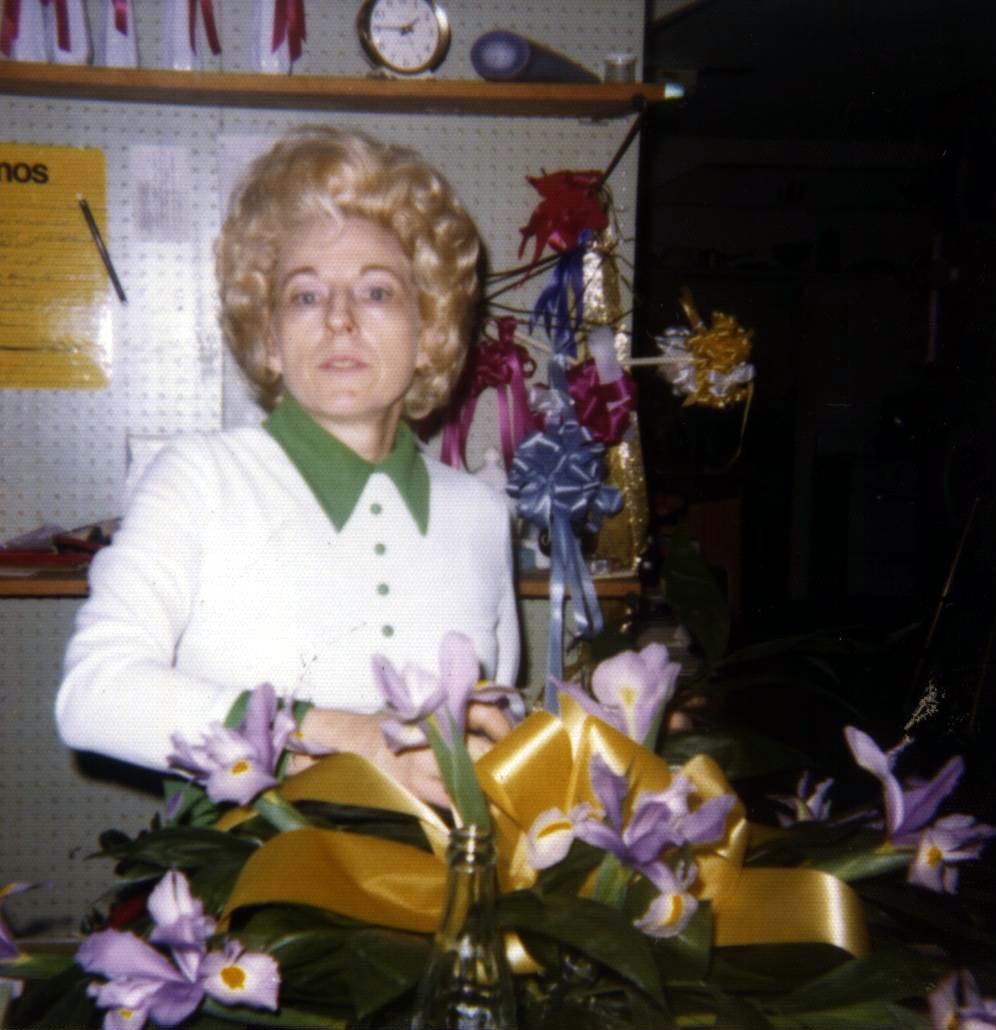
Sissy at the Flower Shop. Houma, Louisiana.

Mildred Dolores Orr

Grandmother

Sissy

Born 1931. Still with us.

Six songs, written for her — one for the flower shop, one for Wyoming, one for the hand she was dealt, one for the five who stand up when she comes in the room, one for the faith that went everywhere she went, and one last one that isn’t ours to say.

The Record

Six songs. Press play, or read the words — they were written to be read as well as heard.

Album cover: Mildred Dolores Orr standing behind an arrangement of purple irises tied with gold ribbon in her flower shop in Houma, Louisiana. The title reads Grandmother.
Grandmother · Six Songs for Mildred Dolores Orr
Cover photograph: Sissy at the Flower Shop, Houma — c. 1972
  1. Track one. Consider the Lilies

    Southern gospel hymn · female alto · slow 6/8

    “Consider the lilies of the field, how they grow; they toil not, neither do they spin.”

    Matthew 6:28

    The flower shop in Houma — and every flower she ever sold, given away.

    Lyrics

    Verse

    The bell above the door would ring, the damp Houma morning coming in. Cool green water, cellophane, a girl with roses to her chin. They called you Sissy at the shop. You cut the stems out on a slant. Nobody called it preaching, Grandmother, but every window was a psalm.

    Chorus

    Consider the lilies, how they grow — they do not labor, do not spin. Not Solomon in all his glory was dressed as fine as one of them. You held them in your hands all day, the very flowers Jesus named. He said, take no thought for tomorrow. Grandmother, you never did.

    Verse

    You made the flowers for the weddings and you made them for the graves. The bride and then the widow came through one door in seven days. You’d lock the door and cut the lights when the last delivery was made, and you went home and trusted God with tomorrow, unafraid.

    Chorus

    Consider the lilies, how they grow — they do not labor, do not spin. Not Solomon in all his glory was dressed as fine as one of them. You held them in your hands all day, the very flowers Jesus named. He said, take no thought for tomorrow. Grandmother, you never did.

    Bridge

    Not one flower that you sold is living now — they never do. But the five you raised are living, and their children, and theirs too.

    Outro

    Consider the lilies, how they grow. He has never lost a one. Grandmother, He is keeping you the way you kept the roses — in cool water, out of the heat, till the morning that He comes.

  2. Track two. Lost Cabin

    Country gospel · male baritone · one voice, close-miked

    “I will lift up mine eyes unto the hills, from whence cometh my help.”

    Psalm 121:1

    Wyoming, and the bronze that was signed but never numbered.

    Lyrics

    Verse

    You sold your flowers in Louisiana, in the wet and easy green, then you left the cypress for the sagebrush and a country hard and clean. And Lost Cabin wasn’t much to speak of, just the wind and stone and road — you lifted up your eyes unto the hills and your help came from the Lord.

    Chorus

    You were signed, but never numbered, not one of any run. They stamped a number on the rest — you were given the only one. That’s how the Lord has loved you, Grandmother: not counted, only known.

    Verse

    You kept the letters and the ledgers there, in a town the wind blew through, where they poured the bronze on winter mornings and the cold came pouring too. You watched a rider rise out of the mold outlive the hand that poured it — and everything that we are, Grandmother, came up under your own hand.

    Chorus

    You were signed, but never numbered, not one of any run. They stamped a number on the rest — you were given the only one. That’s how the Lord has loved you, Grandmother: not counted, only known.

    Bridge

    Sissy, there’s no second casting, there is no second mold. The catalogue never counted you — He numbered every hair. He kept the watch through Lost Cabin, never slumbered, never slept.

    Outro

    Lift up your eyes, Grandmother, He knew your name before Lost Cabin. They called that place Lost Cabin — He never lost you once. You never called Him anything but Jesus, and He has kept your going out, and He will keep your coming in, from this time forth and evermore.

  3. Track three. Sissy’s Got a Killer Hand

    Country story-song · female lead · front-porch two-step

    “Sissy at the Flower Shop.”
    “Sissy’s got a Killer Hand,” 1983.

    Two captions, written on the back of two photographs

    Her whole improbable life, start to finish, in one sitting.

    Lyrics

    Verse

    Down in Houma, Louisiana, where the heat won’t ever break, there’s a girl behind the counter of a little flower shop. Cellophane and green wire and a cooler full of roses — she made ’em up for weddings and she made ’em up for wakes.

    Chorus

    Somebody took the picture and they wrote across the back: “Sissy at the Flower Shop” — four little words, that’s that. But four words on a photograph don’t tell you where she’d go. Set down here a minute, Sissy. This is how it goes.

    Verse

    She up and left the bayou for the high and windy plain, Lost Cabin, Wyoming — named for gold no man could find again. One creek, a few cottonwoods, four hundred miles of sage, and a cold you don’t argue with. You button up and stay.

    Verse

    Out where the nearest town’s three miles off and hardly worth the drive, she kept the books and typed the mail for a man who worked in bronze. Cowboys, busts and horses, all them hard old Western men — and when it come her time to leave, he give her one of them.

    Verse

    Now most folks get a gold watch when they finally quit a job. Sissy got John Wayne in bronze and toted him on home. They put that cowboy on a magazine — there’s twenty in the world, all numbered. Hers ain’t one of ’em. Hers is out there on its own.

    Chorus

    There’s another one they took of her and wrote across the back: “Sissy’s got a killer hand” — nineteen eighty-three, that’s that. And that’s the other half of it, if you want it in a line: they dealt her what they dealt her, and she played it every time.

    Bridge

    Five kids, and a church pew, and a suitcase wore plumb through. She went and saw this whole wide world, the far side of it too. She never missed a Sunday, wherever Sunday found her — she’d have found herself a Baptist church to sit in on the moon.

    Verse

    Well, now it’s Texas, and it’s ninety-four years down the road, and that cowboy’s on the shelf, still signed, still on his own. There’s five kids and their kids and their kids out in the hall — and Grandmother, not a one of ’em was in that photograph at all.

    Outro

    You made ’em up for strangers — every wedding, every wake — and you handed every one across the counter, kept not one. They dealt you what they dealt you, and you played it all the way. Now look around this room, Sissy. Look at what you arranged. Grandmother — this one’s yours.
  4. Track four. Her Children Rise

    Southern gospel · full choir · revival tempo

    “Her children arise up, and call her blessed.”

    Proverbs 31:28

    All five of them named out loud: Steve, Barry, Judy, Rhonda, Nancy.

    Lyrics

    Intro

    Her children arise and they call her blessed — that’s the word she raised us on.

    Verse

    She set the table before she ate, she said the blessing, she made us wait, hymnal open on the kitchen chair, flour on her hands and a word of prayer. She sold flowers down in Louisiana, she sang in church her whole life long, she never once let go of the Book — now look at the room, Grandmother. Look.

    Chorus

    Her children rise — Steve and Barry rise, Judy rises, Rhonda and Nancy rise, strength and honor is the coat she wore, and it fits her finer than before. Her children rise and they call her blessed — oh, her children rise.

    Verse

    Steve stands up, then Barry stands, sons she rocked with her flour-white hands, Judy and Gerry are on their feet, Rhonda and Al in the second seat, Nancy and Howard stand at the end — five that she carried, and she’d carry them again.

    Chorus

    Her children rise — Steve and Barry rise, Judy rises, Rhonda and Nancy rise, strength and honor is the coat she wore, and it fits her finer than before. Her children rise and they call her blessed — oh, her children rise.

    Bridge

    We added a leaf to the table, then we added another one, then we set a card table in the hallway for the children of her children’s children. The Book says her husband praised her too, and the ones who never met her call her blessed.

    Chorus

    Her children rise — Steve and Barry rise, Judy rises, Rhonda and Nancy rise, strength and honor is the coat she wore, and it fits her finer than before. Her children rise and they call her blessed — Grandmother, your children rise.

    Outro

    Steve and Barry, Judy, Rhonda, Nancy, and everyone that came from them, we’ll do the standing, you just rest, while the whole room calls you blessed. Stay in your chair, Grandmother. We’ll do the rising now.

  5. Track five. Even There

    Old-time hymn · four-part close harmony · no drums

    “If I take the wings of the morning, and dwell in the uttermost parts of the sea; even there shall thy hand lead me, and thy right hand shall hold me.”

    Psalm 139:9–10

    The faith that packed itself and went along, every mile of it.

    Lyrics

    Verse

    You found Him in a clapboard room, a bayou town, a Sunday bell, a hymnal worn as an old glove, a Book you loved and knew so well. You tied the ribbons in the shop, you cut the stems and set them right, you raised the five, you kept the faith, and read that Book by kitchen light.

    Chorus

    The same Lord in the cane and snow, the same Lord on the farthest sea, the same in every far-off town, the same as He will always be. You took the morning’s wings and flew, and even there He carried you.

    Verse

    You went out to the high, cold plain, Lost Cabin in the driven snow; you typed his letters, kept his books, and sang the hymns you’d come to know. You crossed the water, heard the bells call out along a foreign street; they sang a hymn you couldn’t read — you knew the tune, and found your seat.

    Chorus

    The same Lord in the cane and snow, the same Lord on the farthest sea, the same in every far-off town, the same as He will always be. You took the morning’s wings and flew, and even there He carried you.

    Bridge

    The traveling is finished now, a chair, a window, and a bed; the miles are over, Grandmother — the same hand rests upon your head. You never stood where He was not. You never once outran His hand.

    Outro

    The morning’s wings are folded now, the far sea quiet as a pew. So rest now, Sissy — He is here. You were home the whole way through.

  6. Track six. Well Done

    Contemporary worship · male lead and choir · the closer

    “Well done, good and faithful servant; thou hast been faithful over a few things, I will make thee ruler over many things: enter thou into the joy of thy lord.”

    Matthew 25:23

    The only song here not sung in our voice. This one is the Lord talking.

    Lyrics

    Verse

    I knew your hands before the roses did, before the cold back room, before the shop. You wrapped up other people’s brightest days and carried lilies in when their world stopped. And nobody kept a ledger of the cost, the six a.m., the aching, all those years. I kept it. Not one morning has been lost. I was standing in the doorway. I was near.

    Chorus

    I kept a room where the light comes in at four. I made it up myself, and it is ready. Set the whole load down outside the door, you won’t need it here, and I know that it’s heavy. Nothing good you gave away is gone, and no one you’ve been missing has been lost.

    Verse

    You laid a table longer than the kitchen. Five chairs, and then the years filled every one. You went across the world and saw the far countries, came home, and hung the washing in the sun. You kept the letters for a man who worked in bronze. He poured out horses that outlived his name. I have been that patient with you all along. What I have made in you will do the same.

    Chorus

    I kept a room where the light comes in at four. I made it up myself, and it is ready. Set the whole load down outside the door, you won’t need it here, and I know that it’s heavy. Nothing good you gave away is gone, and no one you’ve been missing has been lost.

    Bridge

    Ninety-four years, and I watched every one, the ones the world could see, and the ones it missed. They call you Grandmother in a house full of your children. The old photographs still call you Sissy. I knew you first. You fought it out, you finished, and you kept the faith. You were faithful with a few small things, now look what I am handing you. Well done. Well done, good and faithful.

    Chorus

    I kept a room where the light comes in at four. I made it up myself, and it is ready. Set the whole load down outside the door, you won’t need it here, and I know that it’s heavy.

    Outro

    Nothing left to prove now. Nothing left to do. The light is on, the table’s set, the door is standing wide. Everyone you’re missing is a little way inside. Come on in, come on in. Well done, Sissy. Come on in the house.

Her Life

In four movements.

Louisiana

Houma

She comes from Terrebonne Parish, down where the roads run out into water. Houma, Louisiana — deep Cajun country, and a family tree with Orr and Hebert and Day and Winder and Guidry and Authement all tangled up in it. Mardi Gras every single year, no exceptions.

She ran a flower shop. That is the plain fact of it, and it is one of the best facts we have about her. There is a photograph of her behind the counter with an armload of irises and gold ribbon, and the whole of the caption is four words: Sissy at the Flower Shop.

A flower shop in a small town is not a pretty job. It is the weddings and it is the funerals, and often enough it is the same family inside of one week. She made them both. She made them right. Then she handed every last one of them across the counter and kept none of it for herself.

Five children came out of those years — Steve and Barry, Judy and Rhonda and Nancy — and they are the part of the arrangement she did keep.

Wyoming

Lost Cabin

And then she left. She went from the wet green of the bayou to Lost Cabin, Wyoming, which is about as far as those two things can get from one another without leaving the country.

Lost Cabin is not really a town. It sits in Fremont County on the southern edge of the Bighorns, where Badwater Creek and a thin stand of cottonwoods cut one ribbon of green through dry sagebrush hills. The nearest place is Lysite, three miles off. Shoshoni is twenty-two. It takes its name from the old story of the Lost Cabin Mine — prospectors who ran from an ambush with gold in their hands and could never in their lives find their way back to the cabin again.

She went there to be secretary to Harry Jackson, the Western painter and sculptor, who built his studio and his home at Lost Cabin in 1970. The family always told it as Andrew Jackson, which sounded wrong for eighty years and turned out to be right all along: his full name was Harry Andrew Jackson. She kept his letters and she kept his books, out where the wind does the talking.

Jackson had sculpted John Wayne — The Marshal, Wayne as Rooster Cogburn, the one that ran on the cover of Time in August of 1969. It exists as a numbered edition of about twenty bronzes in the whole world. Every one of them is stamped with its number.

He gave her one.

Signed, but never numbered.

Hers was outside the edition. Not one of twenty — the only one. The family still has it.

Everywhere else

The World

She traveled. Widely, and for real — not the kind of traveling you do to say you did it. She went and saw the far side of the world and came home and hung the washing out, and she talks about it now the way other people talk about a trip to town.

She is a Southern Baptist and has been her whole life, and the thing about her faith is that it never once stayed home while she went out. It packed itself and came along. Whatever town she woke up in, she found the church and she found her seat, and if she couldn’t read a word of the hymnal she knew the tune well enough to sing it anyway.

Ninety-four years of Sundays. Louisiana, Wyoming, the far countries, Texas. Same Book, same tune, same woman.

Now

Texas

She lives in Texas. She is ninety-four. She still plays cards, and if you sit down across from her you should understand going in that somebody once thought her hand was worth photographing.

The table has been added to twice — a leaf, and then another leaf, and then a card table out in the hallway for the children of her children’s children. Nobody in this family has an exact count and nobody is especially interested in getting one. The point is the hallway is full.

Everything on this page is here because it happened, and because she is still here to be told about it. That is the whole reason for the record. Not to sum her up — she isn’t finished — but to say it out loud once, in her hearing, while she can sit in her chair and let the rest of us do the standing.

The Photographs

Out of the family album, in the order they happened. The captions are the ones somebody wrote on the back.

Her Children

  1. Steve
  2. Barry
  3. Judy
  4. Rhonda
  5. Nancy

And the children of her children, and theirs.